Stop taking the lender's word for the collateral.
Today the certificate is arithmetic the lender did on numbers the lender chose. Connect their core once and it becomes arithmetic you do on their loans, every fifteen minutes, with the covenants tested as they move.
Recomputed from the lender's own tape, not submitted by the lender
The line drew down 81% in six months and the base kept pace
No single borrower reaches 1% of the pool, and one related party group reaches 35%
Arrears held near 5.5% all year and broke below it in July
Two limits are outside, and both have a named owner and a clock


Working with


You lend to a company once, then watch it through a keyhole.
Underwriting a non-bank lender is a single look at solvency, followed by a credit limit that is supposed to expand in six months on evidence nobody is collecting.
Underwriting is one look, and then it is over
You assess the company at origination and then rely on whether the payment arrives. Whether the book behind it improved or rotted is not something the payment tells you.
You cannot see what the money did
The funds were drawn for a purpose. Whether they reached that purpose, what they originated and how those loans behaved is invisible unless the lender volunteers it.
You find out late, and from the lender
Concentration drift, related party exposure and covenant breaches surface at a quarterly certificate the lender prepares, which is the one document least likely to carry bad news early.
What a warehouse line looks like today.
Every line here is something a credit team does by hand because the data to do it automatically has never been available in one place.
The certificate is written by the party being tested
A borrowing base certificate arrives as a spreadsheet the lender assembled. You are checking their arithmetic on their numbers.
The covenant schedule lives in a document, not in a system
The floors and caps are in the facility agreement. Testing them means someone reading a PDF and typing into Excel, every quarter.
You are often not the first lender
Whether another line already sits against the same collateral, and on what terms, is something you find out by asking rather than by looking.
No two applications answer the same question
Every non-bank lender presents differently, so nothing in the pipeline can be placed beside anything else, and a book disappears behind the format it arrived in.
Custom reporting is a project every time
The one cut your risk committee actually wants is the one nobody has, and getting it means a request, a wait and a spreadsheet.
Effect turns a warehouse line into something you can watch continuously.
The lender you fund authorises a read-only feed from their core. Everything you used to receive as a document becomes a number you recompute at will.
The certificate, recomputed
Eligible collateral after every deduction, the advance rate and the headroom left. Rebuilt from the lender's own tape, not submitted by them.
Nothing is asked of your engineers.
Two things happen: you hand over the covenant schedule once, and the lender authorises a feed. Everything else is ours.
Name a line you already carry
One lender and the facility behind them. Nothing prepared, no data needed from you at this stage.
The lender authorises a feed
A read-only connection to their core, which is why collection takes a day here and three weeks when it is a document request.
We encode your covenants
The floors, the caps and the eligibility rules from the facility agreement become tests that run every fifteen minutes.
The line is under watch
Certificate, tests, concentration and the exception queue, on the platform, over API or as a file on your schedule.
What changes for a bank.
The same facility, the same lender, and a completely different amount of information about both.
You recompute rather than receive
The eligible base is your arithmetic on their records, which is the difference between a certificate and a claim.
Limit reviews start from data
The decision to expand a limit is made on measured behaviour that already exists, rather than on a fresh round of requests.
You see what the money did
What the drawn funds originated, in what sector, at what tenor and how those loans have behaved since.
You are not the last to know
A breach is raised on the day it happens, with the covenant it belongs to and the date the cure period ends.
Connected obligors stop hiding
Related-party links inside the lender's own records, where the lender's own data shows them, before you commit rather than after.
Reporting arrives in your shape
On the platform, as a scheduled file or pulled into your own systems, in whatever cut your risk committee reads.
Every screen you would be working in.
These are the real screens.
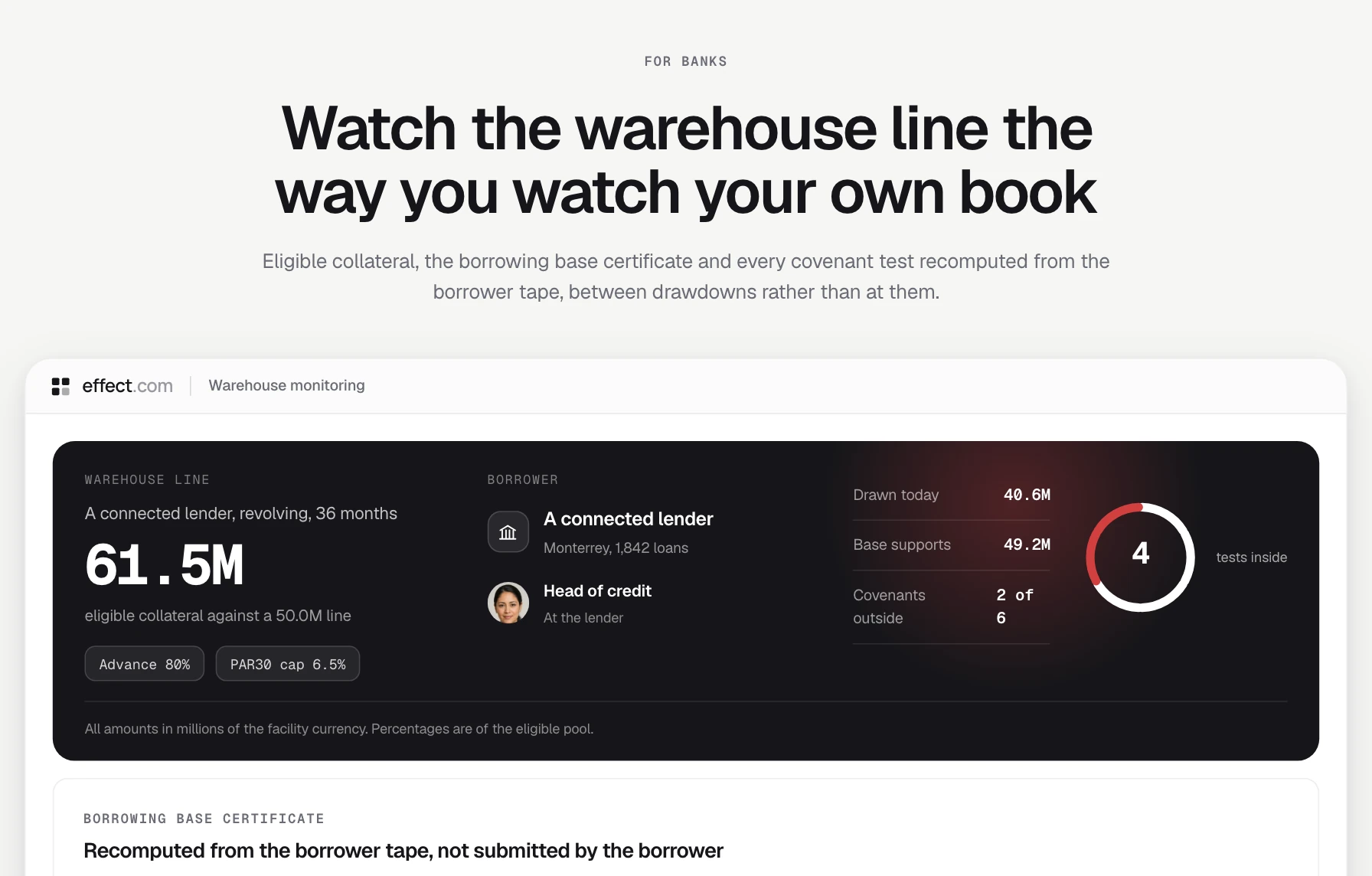
The certificate, recomputed
Eligible collateral, the borrowing base certificate and every covenant test rebuilt from the lender's own loan tape rather than submitted by them.
- Every deduction drawn with the loans behind it
- Six covenant tests, floors and caps alike
- Updated between drawdowns, not at them
Everything a committee asks for. Nothing it did not.
The parts that do the work, described plainly. No model names, no dashboards you will never open, just the four things a lender and an investor both need.
Reconciliation, not retyping
The tape is read from the lending system and tied back to the lender’s own accounts. What does not agree is listed with the loans that caused it.
One record per loan
Every loan carries its own history from the day it was written, so a closed quarter cannot be tidied up afterwards.
rfc → withheld
name → withheldaggregated at portfolio level
Pseudonymised by default
Borrower identities stay with the lender. Reporting is built on pseudonymised records aggregated to portfolio level, under the data processing terms agreed with each lender.
We are not a bureau. We hold no credit bureau licence. We assign no rating, grade or score to any lender, instrument or borrower, and produce no creditworthiness assessment. We read a lender’s own portfolio with that lender’s consent.
Delivered where the investor works
A monthly reading over API or as a file, to the recipients the lender agreed to and to nobody else. Every delivery is logged and visible to both sides.
What changes once the line is watched.
The certificate stops being a claim
Eligible collateral is recomputed from the lender's own loan tape, so the number you lend against is your arithmetic rather than theirs.
Limit reviews stop starting from zero
An expansion at month six rests on six months of measured behaviour that already exists, not on a new round of requests.
Breaches arrive with time left
A limit that goes outside is raised the day it happens, with the covenant it belongs to and the date the cure period ends.
Related exposure inside the pool is visible
The lender's own tape shows which of its loans share an obligor, a legal representative or a registered address, so related-party exposure inside the pool is visible before you commit.
What we read from the lender you fund.
Four sources from that lender's own systems, reconciled into the certificate and the tests your facility already specifies.
Every loan with the date it was written, its terms, its status and its history, pulled from the lending system rather than from a summary.
We do not replace the audit.
An audit reads a closed period once a year, and by the audit date the file is in order.
An audit opens a sample, by design and by standard. It is not built to open every application. The eleven months in between belong to nobody.
Signs the year once it is over.
That signature is the one thing we cannot give you, and we are not trying to. It closes a period that has already happened.
Once a year, on closed quartersHolds the year up to the light while it runs.
Which is the only window in which anyone can still act on what it shows, and the reason an investor keeps lending.
Every day, up to yesterdaySee it on a line you already carry.
Bring one line you already carry and the facility behind it. We will show you the platform on that lender and what you would have been able to see.
A founder reads it and answers within one business day, with a time that suits you.
- ✓A live walk through on a real line
- ✓Custom reporting built to your committee's shape
- ✓A reconciled data pack for lenders that have connected