Bring the fund a book it can price, and the facility stops being a negotiation.
The diligence pack, the borrowing base and the covenant tests all read from your loan tape, so the answer to every fund question is already on the screen.
The book grew 40% and arrears fell in the same year
Every limit in the term sheet, tested continuously
9.5% of the book is unmeasured, and that is the number that costs you pricing
 Head of creditAt the lender
33 of 37 items closed, and the fund wrote the list
 Corporate and legalFinancials
 Loan tape and portfolio data
 Credit policy and underwriting
 Collections and servicingCompliance and AML
Working with


Three things stand between your book and the capital it can carry.
You are not short of borrowers. You are short of a way to show a fund what you already have, in a form it can price without spending six months finding out.
Raising capital takes months and starts again every time
Each fund wants the same figures in a different shape. Your finance team rebuilds the package for the second desk, then the third, and the calendar eats the deal before anyone reaches terms.
Diligence never actually ends
The pack you assembled is stale within a quarter, so the next question restarts the work. Nothing you built for the last investor is reusable for the next one.
Analytics is bought again every time you need it
External analysis, an audit, a data room, a consultant to assemble it. Each one is paid for separately, arrives late, and none of them talk to each other.
What that actually looks like inside your company.
None of these is a failure of your team. They are what happens when the evidence about a lending business lives in six places and none of them is the same place a fund looks.
There is no single place the answer lives
The tape is in the core, the cash is in the bank, the contracts are in a drive and the analysis is in somebody's spreadsheet. Nobody sees all four at once, including you.
Every question becomes a project
A fund asks for arrears by origination quarter. That is a week of somebody's life, and by the time it lands the fund has asked something else.
You wait months for an answer you cannot influence
The process runs on the investor's calendar, not yours, and you have no visibility into which stage it is stuck at or why.
You cannot be compared to anybody
Without a common standard a fund has no way to put your book beside another one, and the safe answer to something it cannot compare is no.
After closing, silence
The facility goes dark for a year, so at the next raise you negotiate from exactly the same position as the first time, with nothing new to show.
Effect is the measurement layer under a lending book.
One platform that measures the book, reads the portfolio continuously and shows a fund the same thing it shows you. Five products, one connection, no data room.
Be readable
Your tape becomes the package a credit committee asks for, and you decide who sees it.
Connect once. Everything after that is ours.
There is no data room to build, no template to fill in and no change to how you originate, price or service a loan.
A call, nothing prepared
Thirty minutes on how you lend, to whom and what the capital would be for. You bring nothing.
We build the connector
Most lenders run software they wrote themselves, so the connector is the work, and it is ours. Read only, one direction, it cannot write to your systems.
You approve what leaves
You choose who sees the book and at what depth. Borrower identities never leave your systems.
The book is live
The package, the borrowing base, the covenant tests and the monthly reporting all run from the connection, and keep running.
What a lender gets out of it.
Everything below is a consequence of the same change: the evidence about your business stops being something you assemble and starts being something that exists.
One place, not six
The tape, the cash, the contracts and the analysis in a single platform that you and the fund read at the same time.
Answers instead of projects
A new cut, a stress case or a covenant test is a query against the connected book, not a week of your finance team.
You see yourself as they see you
The same screen a fund reads, open to you first, so nothing in the process is a surprise you learn about on a call.
Problems arrive early enough to fix
A limit that goes outside is found on the day, while a cure period is still open, rather than at the next certificate.
A track record that compounds
Twelve months of visible behaviour is the asset at the second raise, and it exists only if somebody was reading the tape all along.
You become comparable
The same fields on every book on the platform, which is what lets a fund read yours beside another rather than decline what it cannot parse.
Every screen you would be working in.
These are the real screens.
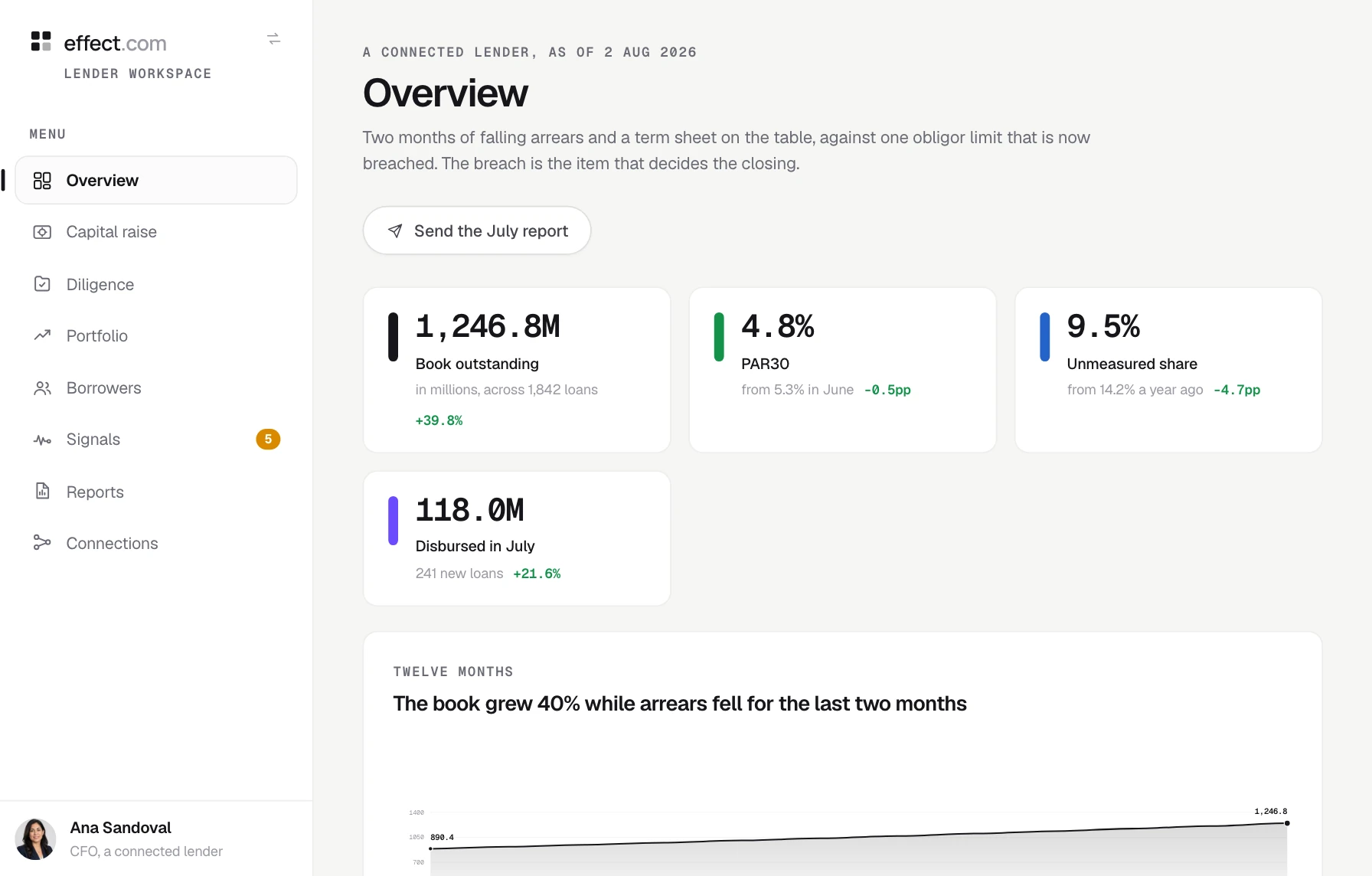
The whole book on one screen
Outstanding balance, PAR30, the unmeasured share and every open signal, rebuilt from your loan tape every fifteen minutes.
- Twelve months of book and arrears on one axis
- Every covenant in the term sheet, drawn against its limit
- Where the exposure sits, by state, against the facility cap
Everything a committee asks for. Nothing it did not.
The parts that do the work, described plainly. No model names, no dashboards you will never open, just the four things a lender and an investor both need.
Reconciliation, not retyping
The tape is read from the lending system and tied back to the lender’s own accounts. What does not agree is listed with the loans that caused it.
One record per loan
Every loan carries its own history from the day it was written, so a closed quarter cannot be tidied up afterwards.
rfc → withheld
name → withheldaggregated at portfolio level
Pseudonymised by default
Borrower identities stay with the lender. Reporting is built on pseudonymised records aggregated to portfolio level, under the data processing terms agreed with each lender.
We are not a bureau. We hold no credit bureau licence. We assign no rating, grade or score to any lender, instrument or borrower, and produce no creditworthiness assessment. We read a lender’s own portfolio with that lender’s consent.
Delivered where the investor works
A monthly reading over API or as a file, to the recipients the lender agreed to and to nobody else. Every delivery is logged and visible to both sides.
What changes once you connect.
Documents stop being the bottleneck
The loan tape is read, reconciled and attached once, instead of being rebuilt for every investor.
Behaviour goes on the record
A year of visible repayment history is worth more at the second raise than any pitch you can write.
Problems surface early
Concentration and related-party exposure appear while there is still time to act on them.
Only mandates that fit
The lender publishes its package to the investors it chooses. Mandate filters show which desks state a mandate for this asset and ticket.
What the platform actually reads.
Four sources, one reconciled view. Nothing here asks you to change how you originate or service a loan.
Every loan with the date it was written, its terms, its status and its history, pulled from the lending system rather than from a summary.
We do not replace the audit.
An audit reads a closed period once a year, and by the audit date the file is in order.
An audit opens a sample, by design and by standard. It is not built to open every application. The eleven months in between belong to nobody.
Signs the year once it is over.
That signature is the one thing we cannot give you, and we are not trying to. It closes a period that has already happened.
Once a year, on closed quartersHolds the year up to the light while it runs.
Which is the only window in which anyone can still act on what it shows, and the reason an investor keeps lending.
Every day, up to yesterdaySee it on your own book.
Tell us how you lend and what the capital is for. We will show you the platform on your own numbers and tell you honestly what the checks return on it today.
A founder reads it and answers within one business day, with a time that suits you.
- ✓A live walk through on your own portfolio
- ✓An honest read before you spend months on diligence
- ✓We say no when the book cannot be reconciled