See the book before the meeting, not after the third one.
Every lender you fund, reporting the same fields on the same schedule, so your own comparison runs on data instead of formats. The lender pays for the platform; your cabinet, the monthly pack and the alerts cost you nothing.
Four books on one standard, each reporting its own PAR30
 Portfolio managerAt the fund
PAR30 as each lender reported it, month by month
9.6% of the funded balance has no bank feed, so no status is reported
Working with


You are asked to price books you are not allowed to see.
A non-bank lender arrives with a deck, its own export and a story. Everything you would need to place it beside the last three is exactly what nobody can give you.
You cannot judge the portfolio, only the presentation
The evidence on the table was assembled by the party asking for money. It is not wrong on purpose, it is simply not something you can verify or recompute.
Every lender presents differently
Four books arrive in four formats with four definitions of arrears. Placing them side by side is a modelling exercise before it is a credit decision.
Credit committee runs on documents that are already old
By the time a pack reaches the committee it describes a quarter that closed. The questions that come back start another cycle of requests.
What comparing and monitoring cost you today.
A fund does not lack capital or opportunities. It lacks a way to see enough, early enough, to say yes or no quickly.
Origination is manual and mostly cold
Lenders are found through brokers, conferences and introductions, and most of what arrives was never going to fit the mandate.
Diligence is bought per deal
External review, local counsel and an accountant, commissioned again for every name, at a cost that only makes sense on the deals that close.
After the money goes out, the book goes quiet
A quarterly pack in the borrower's own format, arriving late, in a shape that cannot be compared with the other three you funded.
Nothing warns you between reviews
A covenant that broke in week two is discovered in month three, which is a different conversation from the one you would have had in week two.
The committee asks and the cycle restarts
One question the pack did not anticipate sends the deal back for weeks, and the answer arrives describing a period that has since closed.
A fund reads the book, not the pitch.
Lenders connect their systems to raise capital. You read what that connection produces: measured books, on one standard, with the reporting already running before you have committed anything.
Books measured on one standard
Non-bank lenders whose books are already connected and read the same way. You see the portfolio before the conversation, not after it.
You do not implement anything.
There is nothing to install and nothing to connect on your side. The lenders you fund connect their books, and your cabinet is what that produces.
Set your thresholds
Asset, ticket size, geography and the tests your committee cares about decide which fields the cabinet shows first. Effect does not select or propose lenders.
The cabinet opens
Lenders who have themselves granted you access. Which of them you approach is entirely your decision.
Request a check
Name a lender that has connected its systems. Where they authorise a feed, the platform measures it on the same standard and returns the full package.
It keeps reporting
Once you fund a lender, the monthly pack and the alerts continue for as long as the money is out.
What changes for a fund.
The same names, the same mandate, and a completely different speed at which you can say yes or no.
Committee runs on current data
The pack describes the book as it is this week, so the questions that come back are about credit rather than about vintage.
Books you did not have to reformat
A lender that has connected can share a measured portfolio before the first meeting rather than after the third.
Every book on the same fields
The same fields, computed the same way on every lender you look at, so no book disappears behind the format it arrived in.
A faster read
Seeing the reported book before the first meeting means your own screen runs earlier.
No surprises between reviews
The day a covenant breaks you know, with the loans behind it, rather than reading about it a quarter later.
Nothing to pay and nothing to run
The lender pays for the platform. The cabinet, the monthly pack and the alerts come with it.
Every screen you would be working in.
These are the real screens.
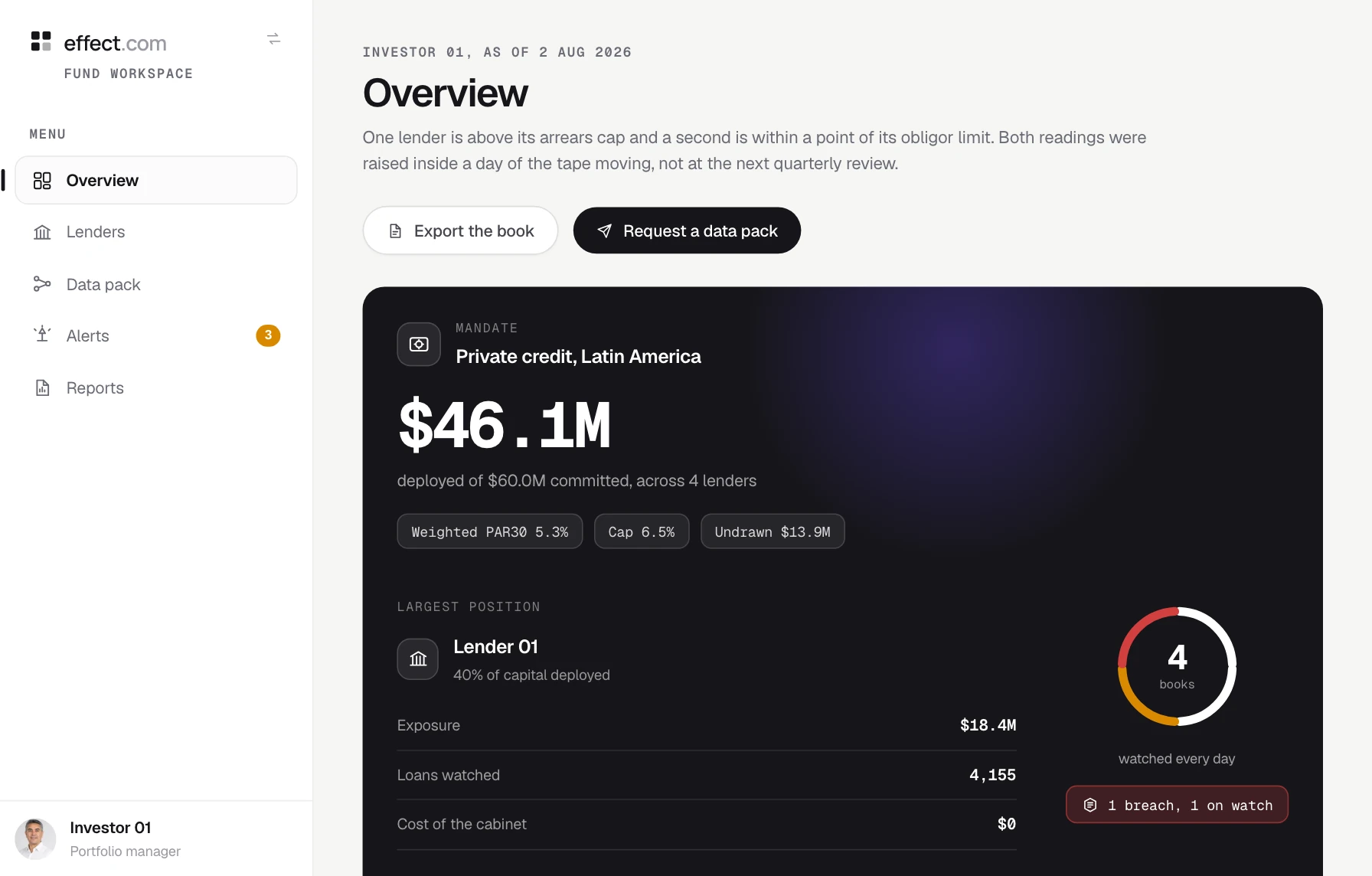
Your whole position on one screen
Deployed against committed, weighted arrears across every book, where the capital ended up and what needs a decision.
- Every lender you funded, one screen
- Weighted arrears across the whole position
- The items that need a decision this week
Everything a committee asks for. Nothing it did not.
The parts that do the work, described plainly. No model names, no dashboards you will never open, just the four things a lender and an investor both need.
Reconciliation, not retyping
The tape is read from the lending system and tied back to the lender’s own accounts. What does not agree is listed with the loans that caused it.
One record per loan
Every loan carries its own history from the day it was written, so a closed quarter cannot be tidied up afterwards.
rfc → withheld
name → withheldaggregated at portfolio level
Pseudonymised by default
Borrower identities stay with the lender. Reporting is built on pseudonymised records aggregated to portfolio level, under the data processing terms agreed with each lender.
We are not a bureau. We hold no credit bureau licence. We assign no rating, grade or score to any lender, instrument or borrower, and produce no creditworthiness assessment. We read a lender’s own portfolio with that lender’s consent.
Delivered where the investor works
A monthly reading over API or as a file, to the recipients the lender agreed to and to nobody else. Every delivery is logged and visible to both sides.
What changes once the books are measured.
Books arrive already measured
The reported portfolio is visible before the first meeting, so your own decision reaches you sooner.
Four books become comparable
The same fields on every lender is the only reason a spread from 3.9% to 6.9% on similar terms is visible at all.
Committee runs on current data
The pack describes the book as it is this week, so the questions that come back are about credit rather than about vintage.
No surprises between reviews
The day a covenant breaks you know, with the loans behind it, rather than reading about it a quarter later.
What we read from every lender you fund.
Four sources, the same four on every book, which is the whole reason two lenders can be placed side by side.
Every loan with the date it was written, its terms, its status and its history, pulled from the lending system rather than from a summary.
We do not replace the audit.
An audit reads a closed period once a year, and by the audit date the file is in order.
An audit opens a sample, by design and by standard. It is not built to open every application. The eleven months in between belong to nobody.
Signs the year once it is over.
That signature is the one thing we cannot give you, and we are not trying to. It closes a period that has already happened.
Once a year, on closed quartersHolds the year up to the light while it runs.
Which is the only window in which anyone can still act on what it shows, and the reason an investor keeps lending.
Every day, up to yesterdaySee the cabinet before you commit.
Name one lender you are watching. We will show you the cabinet you would have on it and what the committee would have seen.
A founder reads it and answers within one business day, with a time that suits you.
- ✓A live walk through on a real lender
- ✓A reconciled data pack for lenders that have connected
- ✓One template across every book you fund